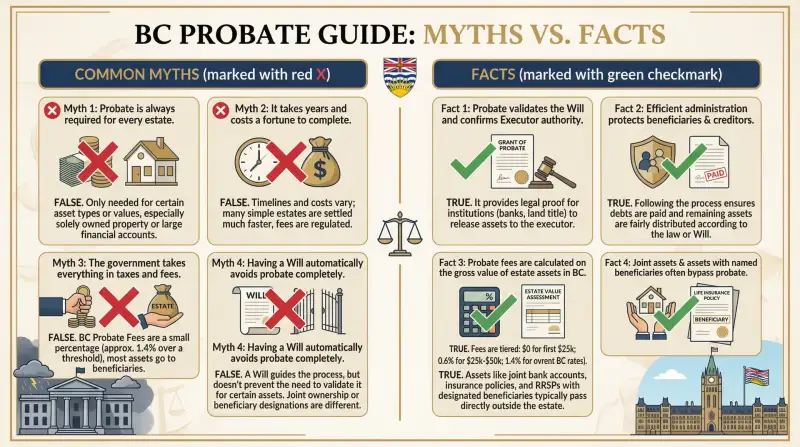
Probate is one of those legal processes that almost everyone has heard of, yet very few people truly understand. Misinformation about how probate works in British Columbia is surprisingly common, and these misconceptions can lead executors and families to make costly mistakes during an already difficult time. Whether you have recently been named as an executor or you are a beneficiary waiting for an estate to be settled, understanding the reality of probate will help you navigate the process with confidence and clarity.
In this article, we tackle five of the most persistent probate myths and explain what actually happens when an estate goes through the probate process in BC.
Myth 1: "Probate is Always Required"
This is perhaps the most widespread misconception about estate administration in British Columbia. Many people assume that every estate must go through probate before any assets can be distributed. While probate is certainly common, it is not universally required.
The Reality: Several types of assets can bypass the probate process entirely, passing directly to named beneficiaries or surviving co-owners without any court involvement. Properties held in joint tenancy, for example, automatically transfer to the surviving joint tenant through the right of survivorship. This means that if a married couple owns their home as joint tenants, the surviving spouse receives full ownership without needing to apply for probate.
Similarly, registered accounts such as RRSPs, RRIFs, TFSAs, and life insurance policies with designated beneficiaries are paid directly to those beneficiaries by the financial institution. These assets do not form part of the probated estate and are not subject to probate fees.
Assets held in a properly established living trust also avoid probate, as the trust is a separate legal entity that continues to operate according to its terms after the settlor passes away. Additionally, very small estates with minimal assets may not require a formal probate application, as some financial institutions will release funds below a certain threshold based on an indemnity agreement.
However, if the deceased owned real property solely in their name or had significant financial assets in accounts without designated beneficiaries, probate will almost certainly be required. The key is to review the specific assets and ownership structures of the estate to determine whether a full probate application is necessary.
Myth 2: "Probate Takes Only a Few Weeks"
Television dramas and movies have given many people the impression that probate is a quick process, where a will is read in a lawyer's office and assets are distributed shortly after. In reality, the probate process in British Columbia is considerably more involved and time-consuming.
The Reality: From start to finish, the probate process in BC typically takes between 6 and 12 months, and complex estates can take significantly longer. The process involves multiple steps, each with its own timeline and requirements.
After the estate holder passes, the executor must first locate and review the will, identify all assets and liabilities, and gather the necessary documentation. The probate application itself must be prepared and filed with the BC Supreme Court, which includes a detailed inventory of all estate assets and their values. Once filed, the court reviews the application, which can take several weeks to several months depending on the court's workload and the complexity of the estate.
After the grant of probate is issued, the executor must still notify creditors, allow time for claims against the estate, file final tax returns, and complete the orderly distribution of assets to beneficiaries. If any disputes arise among beneficiaries or if creditors make claims against the estate, the timeline can extend well beyond 12 months.
Executors should plan for this extended timeline and communicate realistic expectations to all beneficiaries early in the process. Rushing through probate to meet an artificial deadline can lead to errors that create far more serious problems down the road.
Myth 3: "Probate Fees Are Excessive and Avoidable"
Probate fees in British Columbia are a frequent source of anxiety for executors and beneficiaries alike. The fear of large probate fees has spawned an entire cottage industry of fee-avoidance strategies, some of which create more problems than they solve.
The Reality: British Columbia's probate fees, officially known as the probate fee under the Probate Fee Act, are actually quite reasonable compared to many other Canadian provinces and international jurisdictions. The fee structure is straightforward: there is no fee on the first $25,000 of estate value, a fee of $6 per $1,000 on values between $25,000 and $50,000, and $14 per $1,000 on values exceeding $50,000.
For a typical estate valued at $1 million, the probate fee would be approximately $13,450. While this is not an insignificant amount, it represents less than 1.4 percent of the estate's total value. Compare this to Ontario, where probate fees are approximately $15,000 on a $1 million estate, or to the legal and administrative costs of implementing complex probate-avoidance structures.
Some common fee-avoidance strategies, such as adding adult children to property titles as joint tenants, can trigger unintended tax consequences, expose the property to the child's creditors in the event of a divorce or lawsuit, and create complications if family relationships change. In many cases, the costs and risks of these avoidance strategies outweigh the probate fees they were designed to eliminate.
When probate is required, the fees are a legitimate cost of estate administration and are paid from the estate's assets, not from the executor's personal funds. A qualified estate lawyer can advise on whether any fee-reduction strategies are appropriate for your specific circumstances without creating undue risk.
Myth 4: "The Executor Can Sell Property Immediately"
Many executors assume that once they are named in the will, they have immediate authority to sell the deceased's property. This misunderstanding can lead to premature actions that may not be legally valid and could expose the executor to personal liability.
The Reality: In British Columbia, an executor generally cannot complete the sale of real property until the grant of probate has been issued by the BC Supreme Court. The grant of probate is the court's official confirmation that the will is valid and that the executor has the legal authority to act on behalf of the estate. Without this document, the Land Title Office will not register a transfer of ownership, and most buyers' lawyers will not allow their clients to complete a purchase.
The time between the estate holder's passing and the issuance of the grant of probate is typically 2 to 4 months, though it can be longer if the application is complex or if the court requests additional information. During this waiting period, the executor has a duty to secure and maintain the property, but they cannot finalize a sale.
There are limited exceptions. If the will contains a specific power of sale that grants the executor authority to sell property without court approval, and if a buyer is willing to proceed on that basis, a sale may theoretically be possible before probate. However, this is uncommon in practice, as most buyers and their legal counsel prefer the certainty that comes with a grant of probate.
The practical approach for executors is to use the pre-probate period productively by preparing the property for sale, obtaining appraisals, engaging a real estate agent, and beginning the marketing process so that the property can be listed as soon as the grant is received.
Myth 5: "Probate Fees Come Out of the Executor's Pocket"
This myth causes significant anxiety among people who have been named as executors, particularly those who worry about the personal financial burden of administering an estate. The fear of out-of-pocket expenses can even lead some individuals to decline the role of executor entirely.
The Reality: Probate fees, along with all other legitimate costs of estate administration, are paid from the estate's assets, not from the executor's personal funds. This includes court filing fees, legal fees, accounting fees, property maintenance costs, real estate commissions, and any other expenses reasonably incurred in the course of administering the estate.
The executor is entitled to be reimbursed from the estate for any reasonable expenses they personally advance during the administration process. It is important, however, for the executor to keep detailed records and receipts of all expenditures, as they may need to account for these expenses to the beneficiaries or, in some cases, to the court.
In addition to being reimbursed for expenses, executors in British Columbia are entitled to claim compensation for their time and effort in administering the estate. Under the Trustee Act, executor compensation is typically calculated at up to 5 percent of the gross value of the estate, though the actual amount may be adjusted by the court based on the complexity of the administration and the executor's performance.
If the estate has insufficient liquid assets to cover immediate administration costs, the executor may need to advance personal funds temporarily. However, these amounts are treated as a debt of the estate and are repaid before any distributions are made to beneficiaries. In cases where the estate is insolvent, the executor should seek legal advice before advancing any personal funds.
About the Author
The BC Estate Homes team specializes in helping executors and families navigate the complexities of estate sales in White Rock and South Surrey. With decades of combined experience in probate, real estate, and estate planning, we provide expert guidance every step of the way.